

Real Leaders
Where Are They When We Really Need Them?

During the 2000 presidential campaign, David Foster Wallace, the novelist, essayist and humorist best known for his 1996 novel “Infinite Jest,” covered John McCain‘s unsuccessful bid to become the Republican Party’s nominee for President for Rolling Stone Magazine. He rode with McCain’s Straight Talk Express for a week in February of that year and wrote a 15,000 + word essay titled “The Weasel, Twelve Monkeys and The Shrub” that looked at everything from the campaign’s political strategy to the food it catered for the staff1.
In one section of the essay, Wallace wrote that younger voters can’t identify with political leaders because they instinctively sense “bullshit.” He felt that the entire generation born post-19702 was raised with commercials and can’t help but look at the political process as one big commercial. Wallace went on to argue that voters “below the age of 35″ [make that voters under the age of 60 today, considering that the essay was penned over twenty-five years ago] can “smell” the self-serving interests a political candidate has when they ask for votes. No matter what they promise. Wallace said, “We may vote for them the same way we may go buy toothpaste. But we’re not inspired. They’re not the real thing.” Wallace then went on to describe what he meant by a real leader.
“A real leader can somehow get us to do certain things that deep down we think are good and want to be able to do but usually can’t get ourselves to do on our own. It’s a mysterious quality, hard to define, but we always know it when we see it, even as kids. [Real leaders] help us overcome the limitations of our own individual laziness and selfishness and weakness and fear and get us to do better, harder things than we can get ourselves to do on our own.”
Defining what we mean by “Leadership”
Years ago, when I was delivering leadership development programs for some of my client organizations, I opened the programs by asking each group of participants to create their own definition of leadership. Every group seemed to start out with Wallace’s thought that it is hard-to-define-but-we-know-it-when-we-see-it. Then they started stringing together lists of traits and behaviors that are characteristic of people that they recognized as leaders. Finally, they boiled down the lists and arranged the terms and phrases into pictograms that displayed their definitions of leadership.
Here are a few of them:
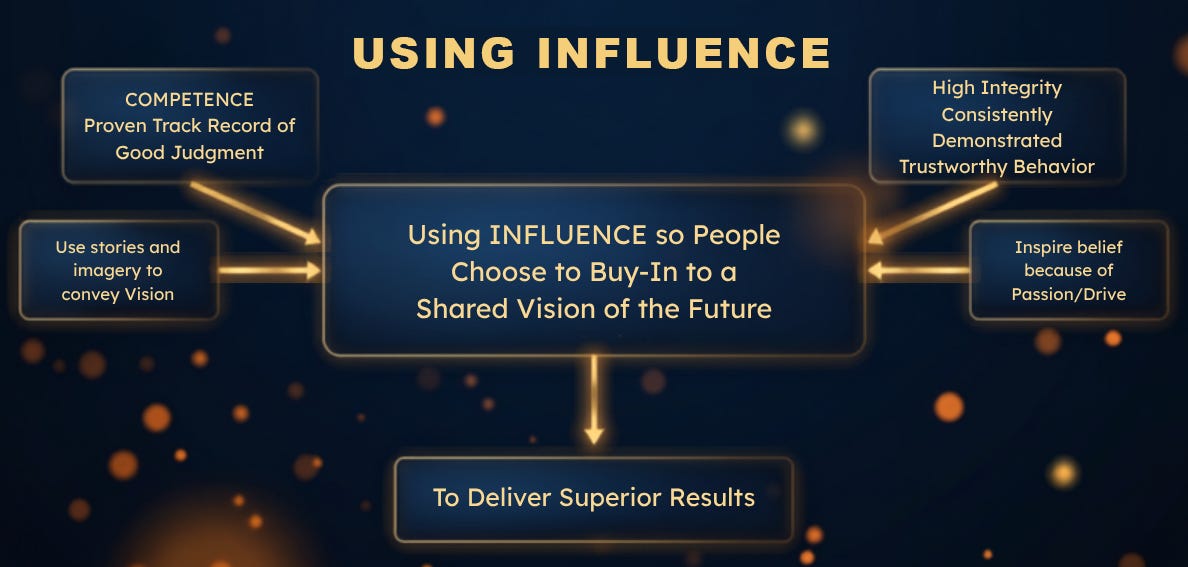
This first one started with the notion that a real leader uses her personal influence to encourage people to buy-in and share her vision of the future. The leader’s influence is built by a consistent history of competence and high integrity. She uses stories and imagery to help convey the vision, and inspires belief because of her passion and drive. And the end goal is delivery of superior results for the organization or community.
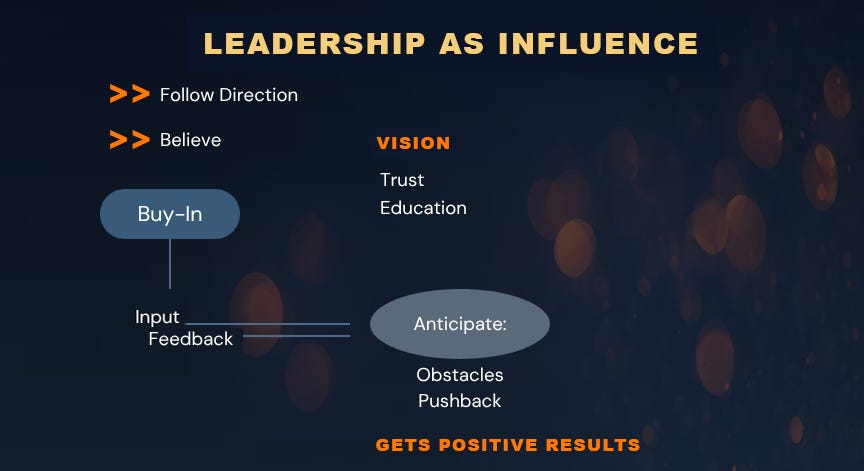
The second example looks at leadership primarily as Influence. The leader lays out a vision, and asks that people follow the direction he is laying out, gaining buy-in because people believe in both him and the vision. Going forward, the leader behaves in a trustworthy manner to help hold things together, seeking and using input from the outside along with internal feedback to adjust course as necessary. It’s also very important for the leader to anticipate obstacles along the way, so that they can be overcome as the organization/community makes progress toward positive results.
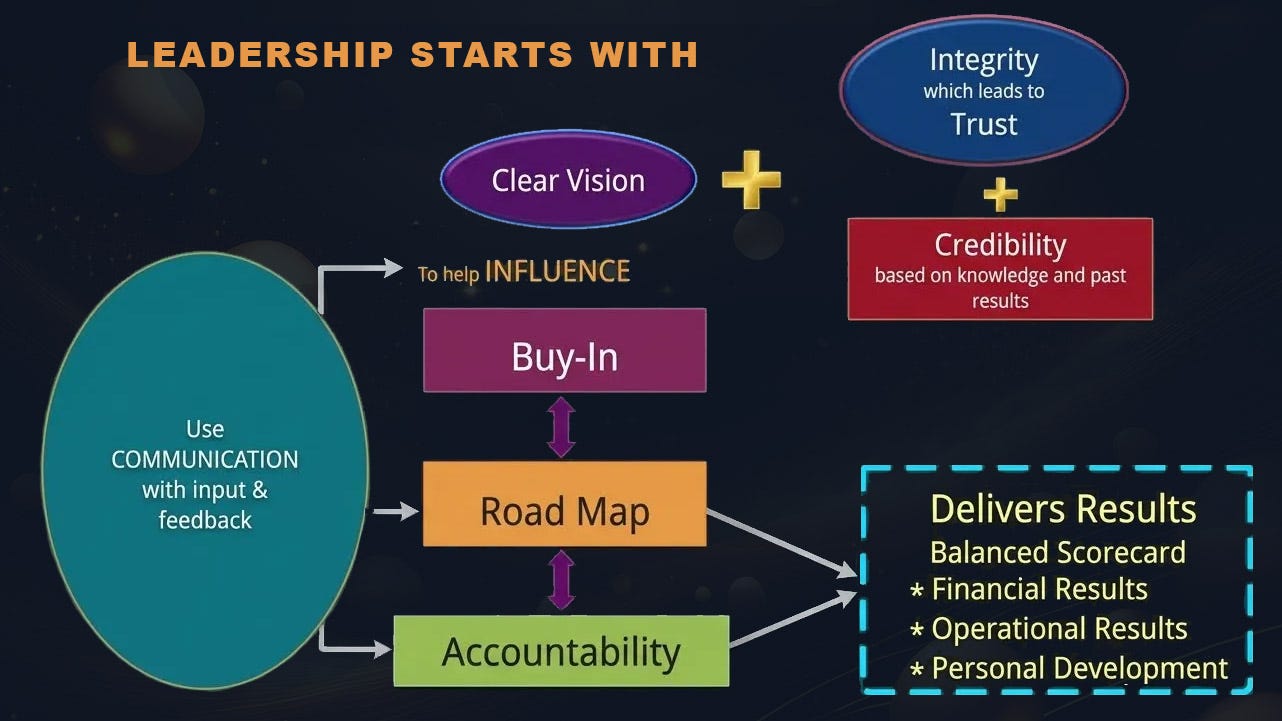
The third example suggests that the essential criteria for a real leader are a clear vision combined with high personal integrity and credibility. The leader uses his personal character to inspire trust, so that his communications to the organization/community will influence them to buy-in to the vision, and to an agreed upon road map to attain the desired results. A key element to driving success is the leader’s demand for and acceptance of accountability
The elements the three examples have in common are pretty obvious. Leaders want to influence other people; to get them to buy-in to some shared vision, to something that is important and gives meaning to their lives. Real leaders know that the foundation of the relationship with those who follow them is acting with integrity and being worthy of trust. We won’t follow someone if we think that they are acting solely out of self-interest. We won’t follow someone we can’t trust. Even kids know that.
Why is it so hard for our political leaders to figure it out?
Choosing Political Leaders
I think that the way we choose our political leaders changes the calculus. Other than for small, local elections, it is highly unlikely that a voter will personally know any candidate for public office well enough to be able to make an informed judgment about the candidate’s competence and integrity.
In California, for example, where I live, each Member of the US House of Representatives represents a District of approximately 760,000 people3. Considering that the average person in the US has only four to five close friends4, and interacts on a weekly basis with between ten and twenty casual acquaintances5, it would be a truly serendipitous coincidence for me or any other Californian to personally know our Congressperson. So, how do I and my 759,999 other citizens in California District 496 find out which of the candidates truly measures up to the qualities that, in our view, make for a real leader?
Candidates are smart. They realize that we learn about the candidates through stories and advertisements in newspapers, on radio and television and through the internet and social media rather than through face to face, personal contact. And it becomes more and more difficult to learn about the real person we are being asked to vote for, when all we can really see is the persona that is created for the sole purpose of winning our vote.
And to make things even more difficult for voters getting to know them, they attack and vilify their opponents. In essence, their message is “My opponent is evil. If elected he will harm you. So, vote for me because I hate them just like you do, and I am the lesser of two evils.”
Without going too deeply into the details, it is worth the effort to at least briefly examine how electoral politics have changed over the past 100 or so years following the introduction of broadcast media. It helps explain why we are in the mess we find ourselves in.
Media and Politics
The first political ads ran on broadcast radio for the 1924 presidential election, during which the candidates aggressively purchased airtime to market themselves directly to voters7, and this permanently shifted the landscape of political elections. Long speeches were quickly out of favor, and the party conventions became media events.
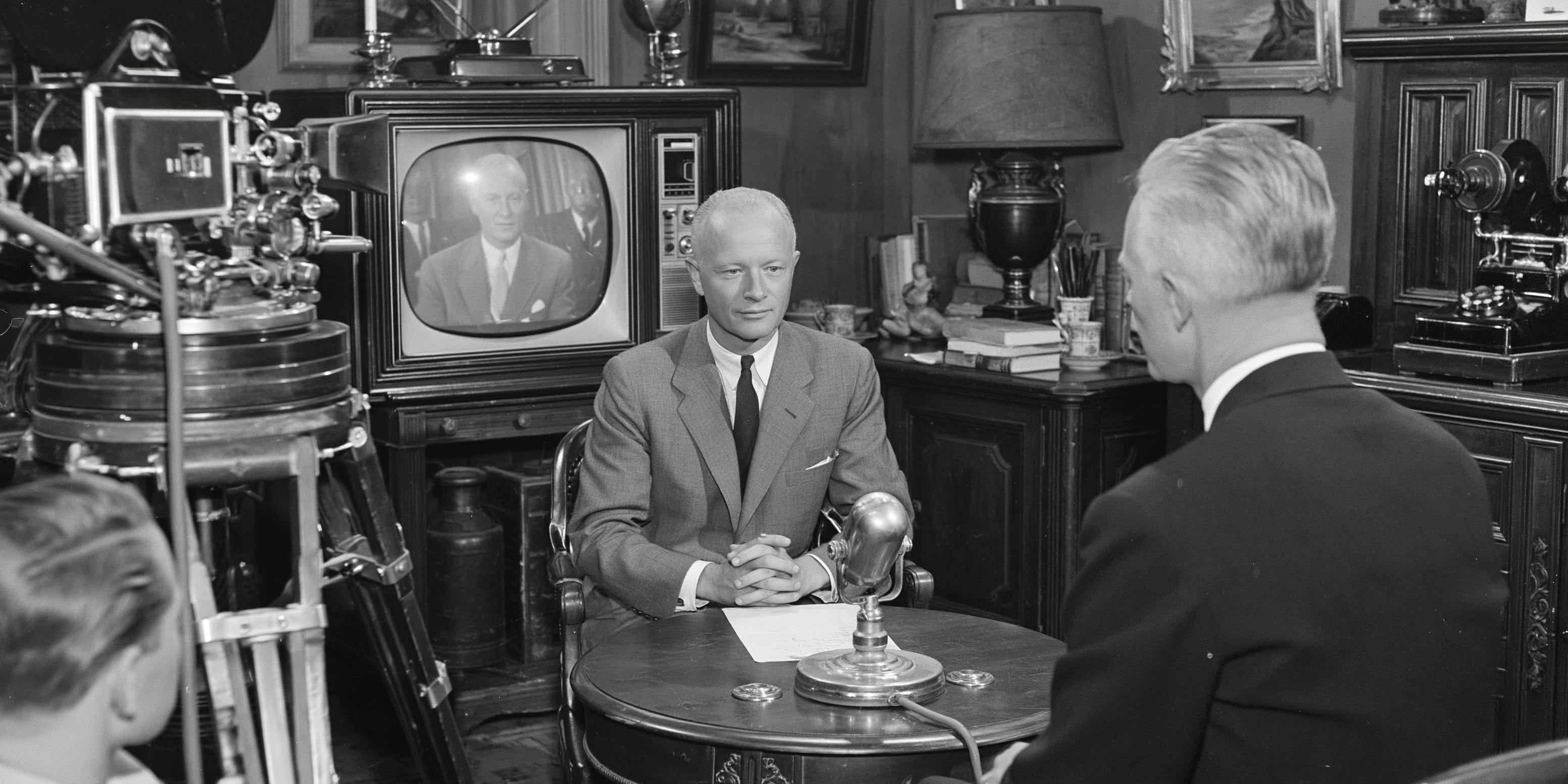
Television was broadly used for the first time in the 1952 presidential election and fundamentally reshaped political strategies. Dwight Eisenhower’s campaign made effective use of 20 to 30-second spot ads to help craft a “TV personality” for the retired Army general8, while his opponent, Adlai Stevenson, turned to much longer 30-minute blocks of late night airtime which he used to read policy speeches. Few voters stayed up late to listen to Stevenson drone on about policy issues. Eisenhower recorded a landslide victory.
The internet first came into play in electoral politics in the 1996 US Presidential Election, when both Bill Clinton and Bob Dole had websites. Social media first became highly used in electoral politics during the 2008 U.S. Presidential Election. Barack Obama’s campaign pioneered the mainstream use of Facebook and Twitter primarily to mobilize voters, but also to raise funds and build grassroots support in ways that had never been possible before.
the 2016 US Presidential Election turned out to be the real game-changer for electoral politics. All of the major candidates shifted to micro-targeted advertising and viral sharing. Facebook data targeting played a very large role, and the election highlighted the emerging issues of echo chambers and foreign influence operations. But the social media impact on the election was largely defined by Donald Trump’s direct, unfiltered communication on Twitter.
Disseminating disinformation became as common, or more common, than distributing information. “Fake News” became a widely used term to disparage the information provided by older, mainstream media, with considerable success. And as people turned to Facebook, Twitter, YouTube and other platforms as their primary source of information, it became much easier to separate people ideologically by presenting messaging that simply cements what they already believe. That leaves little or no room to change opinions through debate, which was once a cornerstone of election politics. The truly alarming aspect is that in the last decade social media has been weaponized to damage an already cracked foundation of trust9.
Where do we go from here?
If we hope to identify and elect political leaders who have high integrity and are worthy of our trust, given that we are highly unlikely to have a close personal relationship with any of our elected federal government leaders [Members of the House of Representatives, Senators, President and Vice-President], we have to rely upon the best available media to obtain information about who they are, what policies they support, and how they plan to govern. That is a formidable task, given today’s media environment.
Social media platforms, which act as most people’s primary source of what we used to call “news,”10 serve as echo chambers that reinforce what people already believe. They allow the disparagement and discounting of any and all opinions that are counter to those beliefs. They provide a platform that allows anyone to put forward an opinion about any issue, without regard to facts, and without doing the hard work of understanding what is really happening in the world before spouting off whatever idea that happens to occur to them in the moment. They make it next to impossible to distinguish information from disinformation.
I love how Beth Macy, in her latest book, Paper Girl, puts it:
“They’re casting stones on social media platforms owned by bigger bullies who profit not by sharing fact-checked reports but by connecting lonely people who crave the addictive, rapid-fire punch of belonging and fear, fight or flight, us versus them—because it helps them sell more shit.”11
If all of this leaves you feeling discouraged, it’s important to remember that creating and maintaining a democratic republic isn’t easy. It’s hard work. Democracy requires interested and involved citizens who demand that their political leaders be responsible and effective stewards of the governing power granted to them. Democracy needs reliable and fact-based media to deliver all of the information called for by an informed electorate. And perhaps most importantly, democracy needs leaders who are public servants rather than power-seekers.
As the United States approaches its 250th birthday, it may help to remember that things haven’t changed all that much since the nation was formed. As James Madison wrote:
“A popular government, without information or the means of acquiring it, is but a Prologue to a Farce or a Tragedy, or perhaps both. Knowledge will forever govern ignorance. And a people who mean to be their own Governors must arm themselves with the power which knowledge gives.12”
To read the edited version published in the magazine, you have to subscribe to the Rolling Stone On-line edition. Or you can buy a copy of the book titled McCain’s Promise: Aboard the Straight Talk Express with John McCain and a Whole Bunch of Actual Reporters, Thinking About Hope, which includes the entire essay.
Now including Generation X, Millennials/Gen Y, and Generation Z.
The population of the entire State of Wyoming, Vermont, and Alaska is fewer than 760,000 people. The permanent cap of 435 seats for the U.S. House of Representatives was formally locked into law by the Permanent Apportionment Act of 1929, though the chamber first reached 435 members in 1913 under the Apportionment Act of 1911. Each representative served an average of approximately 210,000 people when the 435-seat limit was first applied following the 1910 Census. If Congress had continued to expand the House to match population growth using that 1910 ratio (1 member per 210,000 residents), the chamber would be much larger today. Utilizing the official 2020 apportionment population of 331.1 million citizens from the 2020 Census, the House would have 1,581 members today.
American Friendship Project, “The State of Friendship in America 2023,” PLOS ONE (2023): finding that U.S. adults report an average of 4-5 close friends.
O’Brien and Elsworth, “Misestimating Social Contact Frequency,” Organizational Behavior and Human Decision Processes (2025).
Mike Levin currently represents CA District 49. But effective January 6, 2027, due to redistricting that took place early in 2026, I will be in CA District 47 and represented by Dave Kim. I have never met either of these two gentlemen, though I have participated in virtual town halls (via Zoom) with Representative Mike Levin.
The first commercial broadcast occurred in 1920 when radio station KDKA broadcast the results of the presidential election. Richard Gunderman, "100 Years Ago, the First Commercial Radio Broadcast..." The Conversation, Oct. 30, 2020, The Conversation
The 1952 presidential campaign featured a fully animated "I Like Ike" musical ad. The commercial was created by volunteers from Walt Disney Studios and featured a jingle written by Broadway legend Irving Berlin to humanize the retired military general. It’s worth watching, and wondering how anything like it might play out in today’s political world of negative advertising designed to highlight what is wrong with the political opponent rather than what is right about the candidate himself.
For a more complete analysis of the impact of social media on US electoral politics, see Garrett RK. Social media's contribution to political misperceptions in U.S. Presidential elections. PLoS One. 2019 Mar 27;14(3):e0213500. doi: 10.1371/journal.pone.0213500. PMID: 30917154; PMCID: PMC6436681.
By this I mean fact-checked, reliable, and believable information that is widely available.
Beth Macy, Paper Girl: A Memoir of Home and Family in a Fractured America (New York: Penguin Press, 2025), 305
James Madison to W. T. Barry, August 4, 1822, in The Writings of James Madison, ed. Gaillard Hunt (New York: G. P. Putnam’s Sons, 1910), 9:103–109; transcript available via the Library of Congress.
Thoughtful essay, Dave. (So are good leaders born, not made? Or a combo?) Pete Buttigieg’s book “Trust” is a good, quick read on these issues as well. I think you’d like it.